Launching into Learning
Welcome back, our GiGi’s community!
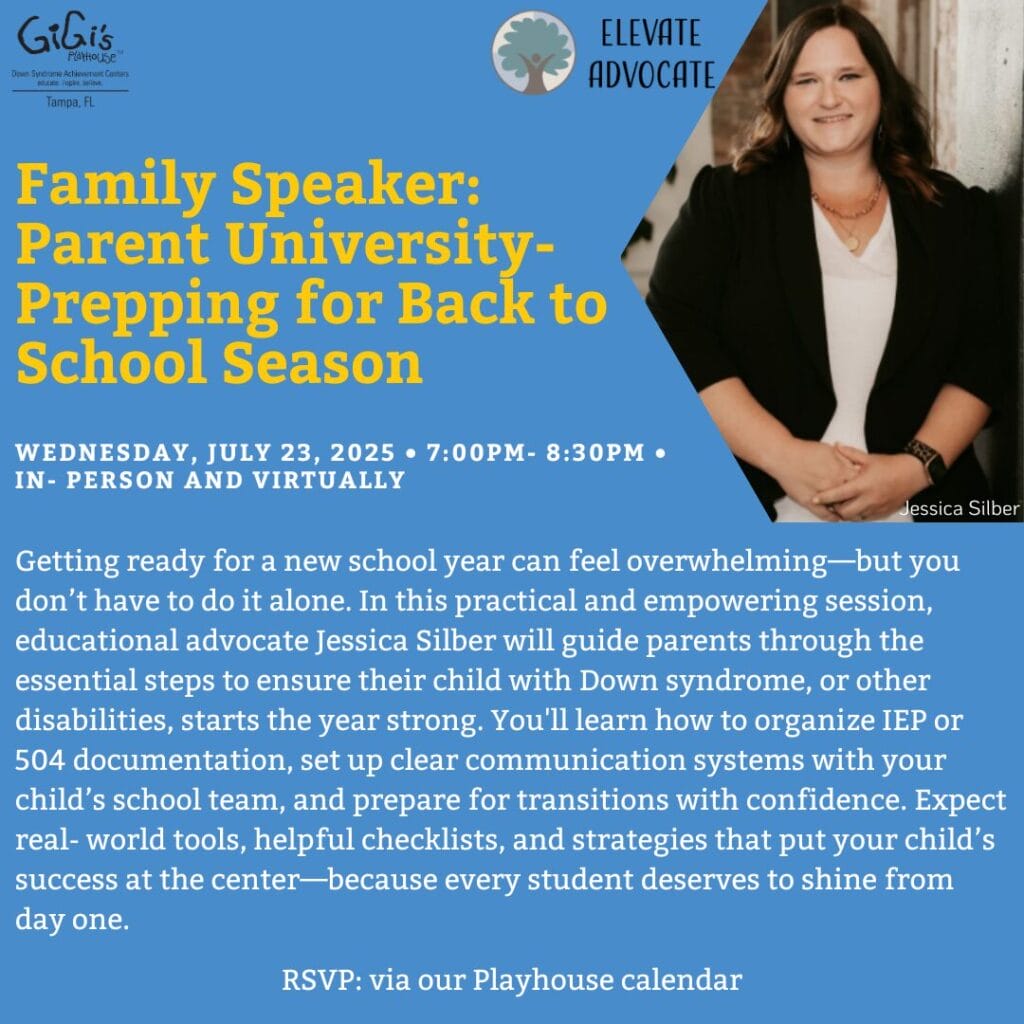
We’re thrilled to share the valuable insights provided by Jessica Silber, our Vice President at GiGi’s Playhouse Tampa, which focuses on education for students with disabilities. Jessica is the Founder of Elevate Advocate LLC, brings over 16 years of experience in disability services, and is also a dedicated parent of a child with autism.
Elevate Advocate was created to ensure that educational needs are met for everyone, enabling them to achieve success in learning. The Multi-Tiered System of Supports (MTSS) is a framework that allows schools to provide tailored support to students, enabling them to succeed according to their individual needs.
This includes three tiers:
Tier 1: Core Instruction (universal instruction)
-All students in an inclusive learning setting
-This tier is preventive and proactive
-80-90% of students
Tier 2: Interventions (targeted instruction)
-Students are put into small groups and given additional instruction
-This tier involves high efficiency and rapid response
-5-10% of students
Tier 3: Interventions (individual instruction)
-Students are provided with one-on-one intervention
-This tier is assessment-based and is high intensity
-1-5% of students
The Individuals with Disabilities Education Act (IDEA) is a Federal law, with the Individualized Education Program (IEP) being a large part of this. Students who need additional services in schools apply to receive an IEP.
The essentials in IDEA:
- Free Appropriate Public Education (FAPE)
- Least Restrictive Environment (LRE)
- Parental rights (consent, participation, dispute resolution)
- Related services: speech, occupational therapy, behavior support
IDEA has 13 categories of disabilities that a child’s diagnosis must fall under to be eligible for their special education services. These categories include: autism spectrum disorder, deaf-blindness, deafness, emotional disturbance, hearing impairment, intellectual disability, multiple disabilities, orthopedic impairment, other health impairment, specific learning disability, speech or language impairment, traumatic brain injury, and visual impairment. The steps to navigating this process include pre-referral, referral, informed consent, an IEP meeting, and then an evaluation.
These services include educational placement to ensure that they are educated in the least restrictive environment appropriate for their individual needs, allowing them to learn efficiently and comfortably. The continuum of education placements offers seven options for evaluating the best possible learning environment for a student, tailored to their individual needs. This continuum is represented in the least to most restrictive environments:
- A regular classroom with a general education teacher
- A regular classroom with accommodations, such as co-teaching with aides, push-in services, and/or assistive technology. Students with and without disabilities are educated together in this setting.
- A regular classroom with pull-out services, having specialized academic instruction or intervention, such as Speech or ABA. Students with disabilities spend most of their time with peers who are not disabled.
- A separate classroom where all students have IEPs. Students with disabilities spend little to no learning time with peers who are not disabled.
- A separate school for students with disabilities. These are non-public schools where only individuals with disabilities attend.
- Home education options, including independent study, home hospital, and homeschool charter.
- Residential or institutional care–the most restrictive environments.
This may all sound like a lot, being a stressful and tedious process, but you are not in it alone, and there are ways to make this easier, ensuring the success of your child. To start, you should review your child’s IEP or 504 plan, send a welcome email to teachers, prepare a visual schedule or routine, track communication and services from Day 1, and create and share a one-page “About Me.” When creating an “About Me” page, you should include a smiling photo of your child and highlight their strengths and interests. You should also list communication, sensory, and behavior tips. Additionally, please ensure that you provide accurate medical information and list your emergency contacts. Including this information in your page will enhance the effectiveness, safety, and comfort of your child.
To stay organized, it is helpful to use a communication log, keep copies of work samples and notes, email service providers monthly for updates, and log missed sessions or changes in behavior. It is also crucial to build strong school relationships. To do this, you should assume good intentions but also document everything, so you are always clear, safe, and aware. You should also ask clarifying questions at meetings to show understanding and demonstrate genuine interest and care. Bringing a trusted person to an IEP/504 meeting is also helpful, as it provides a second pair of eyes and ears. It is also essential to celebrate small wins and express appreciation. What may seem like a small step is truly progress that goes a long way; it is another step towards you and your child’s goals and future aspirations.
Make sure to take care of yourself as a parent, too. To ensure the happiness of your child, it is also crucial to take care of your happiness. This can be demonstrated by creating a routine that includes regular breaks for yourself. Taking steps back for your mental health and creating a space for relaxation is necessary, while also celebrating your own wins. It can also be helpful to reach out to support groups or advocacy organizations for additional support. It’s okay not to know all the answers, as this is a learning process and you are only human! The fact that you are trying and willing to learn is already huge in itself. You are doing a fantastic job; make sure to recognize that.
Be sure to check out our programs calendar on our website to register for the next Family Speaker: Parent University Program night. This program is every fourth Wednesday of every month from 7:00- 8:30pm. It is held both virtually, as well as in- person at the Tampa Playhouse. https://gigisplayhouse.org/tampa/sfcalendar/
Recent Posts