Proprioceptive Sensory System
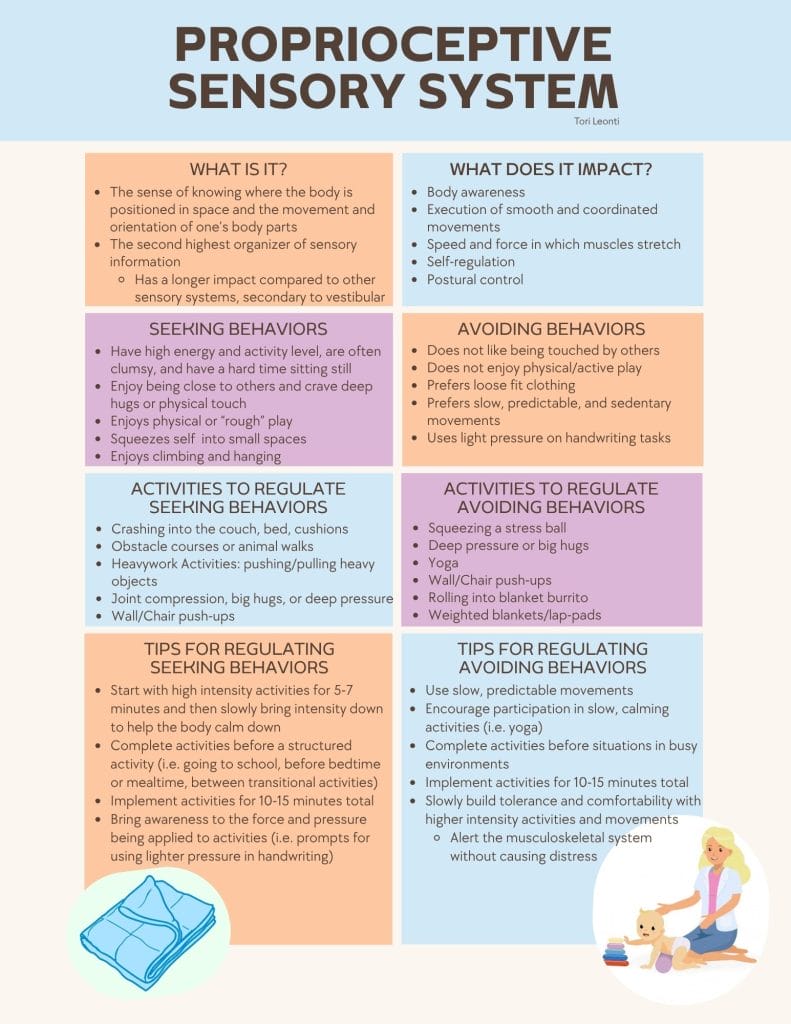
Proprioception is one of our “hidden” senses but is always communicating with our brain and body. Our proprioceptive receptors are located in our joints and muscles, so every time our body moves or our posture shifts, those receptors talk to our brain!
Proprioception helps us understand our bodies, learn new skills, and use our bodies in a coordinated manner. These following terms are very important terms to consider when thinking about proprioception and help us engage in activities that are purposeful and meaningful to us.
- Motor planning or praxis refers to the ability to execute motor movements in a coordinated and organized way.
- When motor planning is impaired or delayed, we may struggle to use both of our hands together for tasks like cutting with scissors, catching a ball, completing a puzzle, washing the dishes, and taking a shower.
- Body awareness or body scheme refers to the brain’s unconscious map of the physical body.
- When our body awareness is impaired, we may struggle to navigate around our environment without bumping into walls or tripping over objects on the floor, move our limbs without looking at them, or use appropriate force when manipulating objects.
- Heavy work refers to activities that require a lot of muscles and joints to work together.
- Heavy work activities, like pushing, pulling, lifting, and carrying, provide a lot of proprioceptive input to the body, helping to calm the body, and regulate the nervous system.
Proprioception allows us to get dressed in the morning, squeeze toothpaste onto our toothbrush, tie our shoes, carry groceries inside, play outside, sit upright at our desk in school, and climb on equipment at the playground.
Proprioceptive Activities:
There are many ways we can provide proprioceptive input in school, in the therapeutic setting, and at home. Many activities require little to no equipment or tools, so we can do them anywhere!
- Animal walks
- Riding a bike or scooter board
- Wall push-ups
- Crash into couch cushions
- Squeeze into a tight space
- Give big bear hugs or tight squeezes
- Squishing between two couch cushions
- Pushing the shopping cart
- Carrying something heavy
Proprioceptive activities are so regulating for the body and can be a useful tool to help prepare children for tasks or situations that may be overwhelming or challenging!
Recent Posts