We Have an AAC Device…Now What?
Augmentative and Alternative Communication, or AAC, includes tools that help someone communicate when speech alone is not enough. Your family might call it a “talker,” a “tablet,” or simply a communication device.
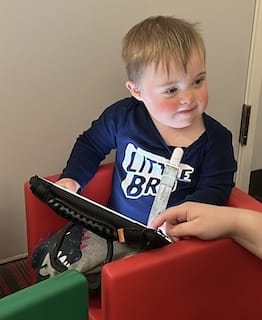
You finally got the AAC device.
You were hopeful it would make communication easier.
But now you may be thinking…
“It’s sitting in the closet.”
“My child doesn’t want to use it.”
“We don’t really know how to use it.”
“It’s too cumbersome.”
If any of this sounds familiar, you’re not alone. We hear these concerns from families all the time.
The good news is that it doesn’t have to stay that way.
Getting the Device Is Just the Beginning
Receiving an AAC device is an important step, but it is only the beginning.
Learning to use AAC is a lot like learning a new language. A child doesn’t learn it simply because the device is available. They need time, practice, support, and opportunities to see it used throughout their day.
Progress doesn’t happen overnight, and that’s okay.
Model Without Expecting a Response
One of the best ways to help someone learn AAC is through modeling.
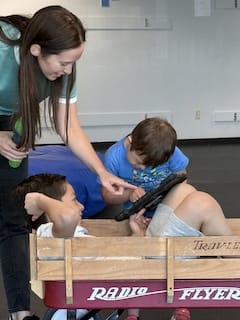
Modeling means using the AAC device yourself while you talk. You don’t need to model every word, and you don’t need to ask your child to copy you. Start with one or two meaningful words.
During a meal, you might model “eat,” “more,” or “drink.” While playing, you might model “go,” “stop,” “fun,” or “again.”
Keep talking naturally. The AAC system supports your speech. It doesn’t replace it.
Make AAC Part of Everyday Life
AAC shouldn’t only come out during speech therapy or homework.
Use it during meals, reading books, playing games, grocery shopping, getting dressed, or riding in the car. These everyday moments give your child repeated opportunities to see how communication works.
And don’t worry about being perfect.
You don’t need to know where every word is or model complete sentences. Small moments, repeated consistently over time, make a big difference.
If It Isn’t Working, Ask for Help
Sometimes a device needs updated programming. Sometimes it is no longer the best fit. Sometimes families simply need a little guidance getting started.
If the device has been sitting on a shelf or feels overwhelming, don’t assume you have failed or that it’s too late.
Talk with your speech-language pathologist.
If you are part of the Amina Grace Speech Therapy Program at GiGi’s Playhouse Phoenix, Sarah Hales, Director of the Amina Grace Speech Therapy Program, can help, as can any of our Amina Grace speech-language pathologists.
We’re happy to answer questions, troubleshoot challenges, and help you make the most of your child’s AAC system.
You don’t have to figure it out on your own!
Want to Learn More?Cookies and Core Video
A simple demonstration of modeling AAC during an everyday activity.
https://youtu.be/kGFqjhKajdM
AAC Modeling Video
A helpful introduction to modeling language naturally throughout everyday routines.
https://youtu.be/1Ln00va69Pg
PrAACtical AAC
https://praacticalaac.org/
About the Author
Sarah Hales, M.A., CCC-SLP, is the Director of Clinical Programs & Impact at GiGi’s Playhouse Phoenix. She has more than 30 years of experience as a speech-language pathologist and has a special interest in Augmentative and Alternative Communication (AAC). Sarah oversees the Amina Grace Speech Therapy Program and is passionate about helping individuals with Down syndrome reach their communication potential while supporting families with practical, evidence-based strategies.
Recent Posts