Why Guitar Group?
When people hear about our Guitar Group at GiGi’s Playhouse, they often ask a simple question: Why guitar?
The answer is simple: because everyone deserves the opportunity to learn and enjoy music.
To borrow a phrase from the Miracle League, whose slogan is “Because everyone deserves a chance to play baseball,” I believe everyone deserves a chance to play guitar. The guitar is an incredible instrument that has played a major role in shaping music across generations and genres. It brings people together, builds confidence, encourages creativity, and provides a fun way to express oneself.
If you know my son, Dustin, then you know that music is a big part of our lives. Music has always been something we enjoy together, and over the years it has become one of our favorite ways to connect. In fact, I own at least ten guitars! Sharing that passion with others seemed like a natural way to give back to GiGi’s Playhouse, an organization that has provided so much support and encouragement to our family.
The idea for Guitar Group actually grew out of another successful program at the Playhouse. Dustin and I participated in the wonderful Ukulele Group taught by Julia Colby. It was such a positive experience for both of us that it sparked an idea: what if we could create a similar opportunity for participants who wanted to learn guitar?
With that inspiration, Guitar Group was born.
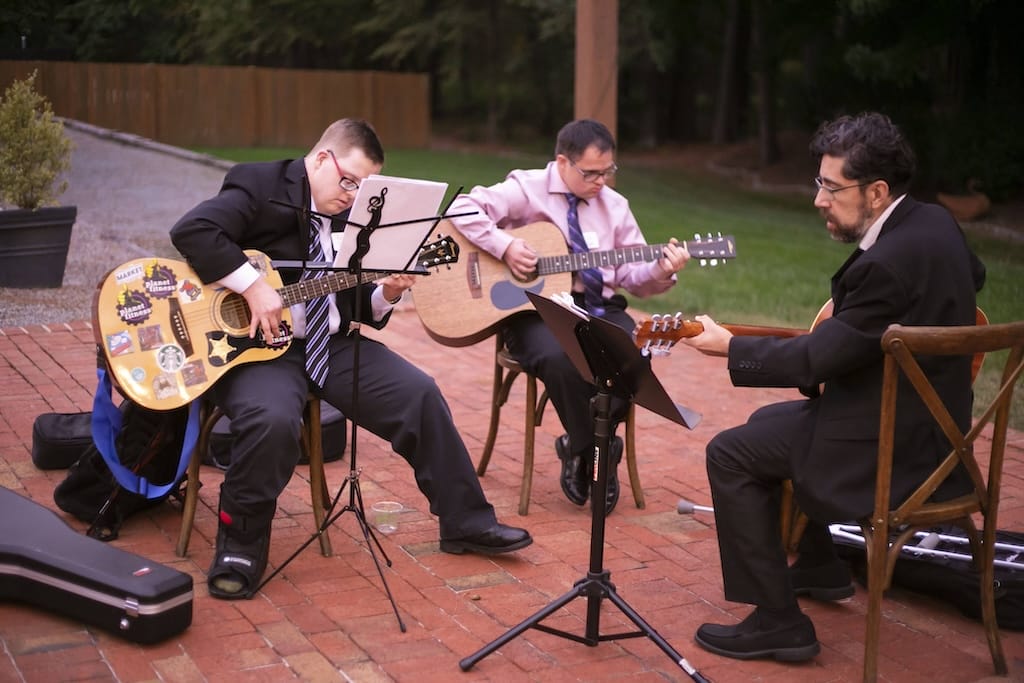
We started small, with just three participants. Over time, interest grew, and today the group has expanded to six participants who meet regularly to learn, practice, and most importantly, have fun making music together.
Learning guitar is not easy. Unlike some instruments, it requires a combination of finger strength, dexterity, coordination, and memory. Players must learn where to place their fingers, how to move between chord positions, and how to strum while keeping a steady rhythm. For many beginners, that can feel overwhelming.
To make the learning process more accessible, we began using large visual posters that clearly showed how each chord was formed. We started with just two or three chords and focused on helping participants switch between them while playing simple, familiar songs. The goal was to make learning fun from the very beginning.
After all, the most exciting part of learning guitar is being able to play actual songs.
Seeing participants strum along with smiles on their faces was incredibly rewarding. However, we quickly realized that mastering only a few chords could only keep things interesting for so long. To continue growing, we needed to introduce more chords and a wider variety of songs.
That challenge led us to rethink our teaching methods.
After researching different guitar instruction books and methods, I began experimenting with ways to simplify traditional guitar chords. Inspired by techniques used in ukulele instruction, I developed simplified one-finger chords based on the root note of each chord. These modified chords still allowed participants to play recognizable songs while reducing the amount of finger movement, motor planning, and memorization required.
The results were remarkable.
Participants were able to learn more chords, transition more successfully between them, and gain confidence in their playing. As their skills grew, so did our song list. What started with simple two-chord songs eventually expanded to include songs that use three or more chords.
For some participants, additional visual supports were still needed. Once again, we borrowed a successful strategy from ukulele instruction. We placed colored dots behind specific strings on the guitars. Instead of saying, “Move from a G chord to a C chord,” we could say, “Move your finger from the yellow dot to the green dot.”
This simple adaptation made a tremendous difference. The color-coded system provided an easy visual cue that helped participants navigate chord changes with greater independence and success.
Today, Guitar Group continues to grow and thrive. Participants play an impressive variety of songs, ranging from “Achy Breaky Heart” to “Sweet Home Alabama.” More importantly, they are developing musical skills, building confidence, and experiencing the joy that comes from making music together.
We are also excited about the possibility of showcasing the group’s talents at the GiGi’s Playhouse Gala this fall. It would be a wonderful opportunity for participants to share what they have learned and celebrate their accomplishments with the community.
So, what’s next?
As interest in the program continues to grow, we hope to add a second Guitar Group and continue collecting donated guitars so that anyone who wants to participate can do so, regardless of whether they own an instrument.
Our goal has always been simple: create opportunities, remove barriers, and make music accessible to everyone.
Because at the end of the day, everyone deserves a chance to play guitar.
Written by Ron Faulkner
Recent Posts